
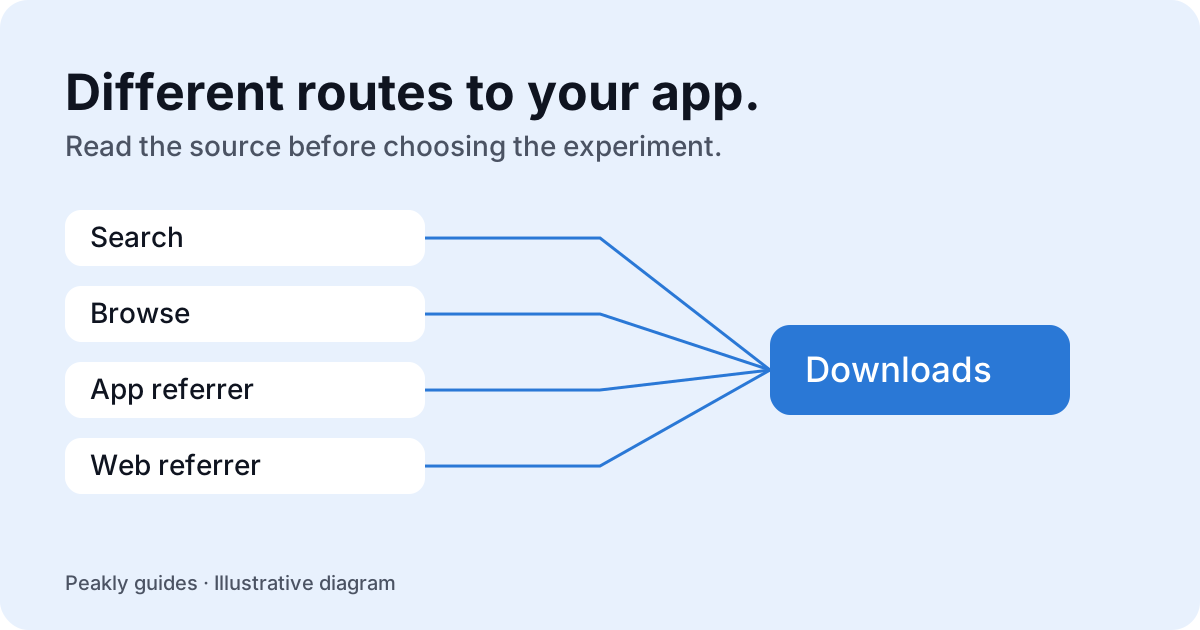
App Store download sources help you decide which part of discovery to investigate next. A rising download total does not explain whether people found you through search, browsing, another app, or a website. The source mix gives the total context, but it still describes reported attribution rather than proving why an individual person chose your app.
Understand the main source labels
Apple's acquisition documentation describes App Store search, App Store browse, app referrer, and web referrer, along with other attribution categories. Search includes activity from search results, including ads shown there. Browse covers discovery while browsing the store. Referrer categories describe links leading into the product page. See Apple's acquisition definitions for the current scope and exceptions.
For iOS, a visit from a website in a non-Safari browser can be attributed to that browser app under app referrer. This is one reason the label web referrer should not be treated as every visit that originated somewhere on the web. Use the documented categories as they are, rather than silently renaming them to fit a marketing story.
Peakly presents source metrics from Apple's reports so you can inspect the counts behind an insight. A source label is not an individual-level journey or a complete marketing attribution system. It also cannot tell you which search keyword produced each download. The current app does not turn the search bucket into separate paid-campaign reporting.
Start with counts, then compare shares
Suppose an illustrative report contains 100 first-time downloads from search and 20 from web referrers. Search represents a larger share of those downloads. That does not mean the website is ineffective: the report alone does not tell you the effort spent on each channel, how much exposure each received, or whether their audiences were comparable.
Record both the number and the share for each source. A source's share can fall because another source grows, even when its own download count rises. Ask which of those changes matters for the experiment you want to run. Avoid labeling a channel a failure solely because it contributes a smaller percentage of a changing total.
Keep the date window, app, and download definition consistent. Mixing first-time downloads in one comparison with total downloads in another changes the question. Similarly, a source with only a few observations should not be ranked confidently against a much larger one. Conversion and sample size deserve a separate check before drawing a verdict.
Look beyond the full product page
Some downloads happen directly from search results without opening the full product page. Peakly's source insight can call attention to that reported pattern. In that situation, the assets visible in the results deserve a closer look. A long description on the full listing is not the only place where a developer can investigate a discovery problem.
One possible experiment is to test the icon, title, subtitle, or early screenshots, changing one element at a time. The current insight offers a suggestion, not a guarantee that the chosen asset is the cause. The source mix helps narrow the question; it does not replace your judgment about the app and the people you want to reach.
For a search-focused comparison, write down a measure such as search downloads per search impression. Keep the source explicit in both parts of the ratio. Dividing all downloads by search impressions would mix traffic that the denominator does not describe. Account for differences in reporting windows before comparing the result with a previous period.
Use downstream outcomes carefully
A download is an acquisition event, not proof that a user found value or became a paying customer. Peakly can examine reported installs, deletions, purchases, and subscription activity where those reports are available. Its current policy requires at least 20 first-time downloads from a source before comparing that source's after-download numbers.
This minimum is another product heuristic, not a universal statistical guarantee. Period totals can include activity from people who installed earlier. A deletion count in the same week as a download count is not automatically a retention rate for that week's new users. Treat such comparisons as directional evidence and retain the insight's caveats.
Turn the report into one next step
Choose a source you can act on, one asset or distribution change, an outcome to watch, and a reason to reconsider the result. For example, a higher search download rate accompanied by worse deletion behavior is a different result from a rise with stable downstream indicators. Neither comparison alone establishes causality.
Use the report coverage guide to check for missing or unsettled days before deciding a channel changed. Peakly separates observations from possible reasons and suggested tests. Explore the current app to inspect the evidence, or share a source-report question if a label or comparison needs a clearer explanation.