
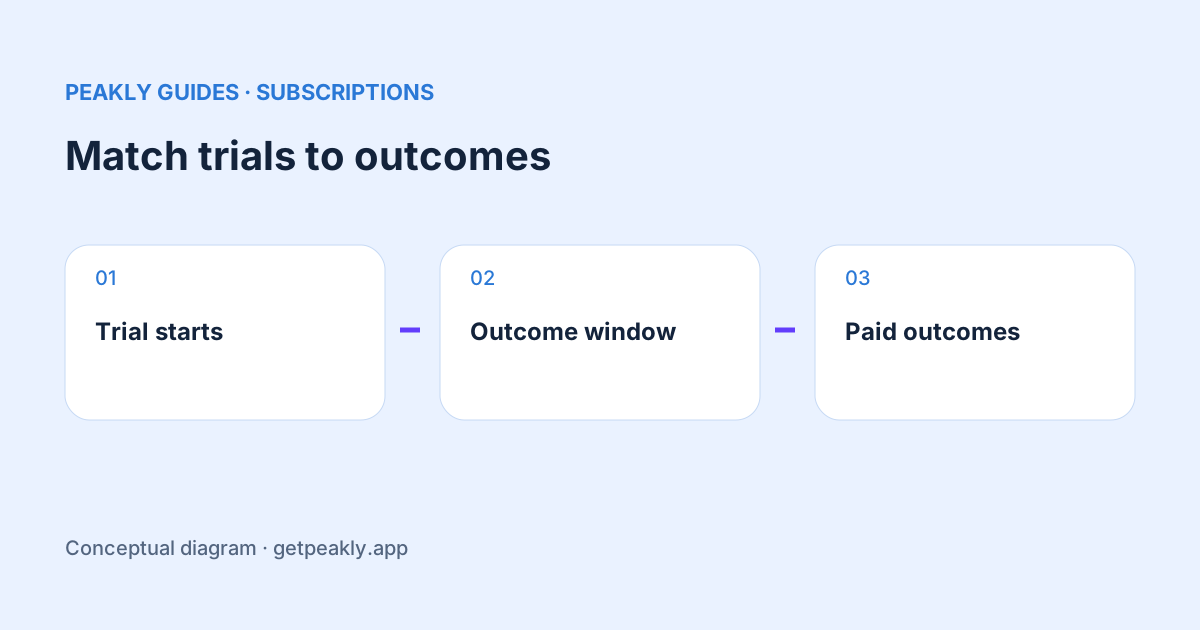
Trial-to-paid conversion needs a denominator that describes trials with an opportunity to reach the paid outcome. Dividing this week's conversions by this week's trial starts can combine different groups of subscribers. Before judging the offer, identify the trial population, its duration, the outcome window, and whether your report follows a cohort or only supplies totals by date.
Decide which question the rate answers
One question is: “What share of the trials that started during this period eventually became paid?” Another is: “How many trial-related paid events occurred this week compared with recent trial activity?” The first requires an appropriate cohort and follow-up window. The second can be a descriptive period comparison, but it should not be labeled as though it followed the same subscribers.
Apple defines its trial-to-paid metric around completed trial offers. Consult the subscription rate definitions before comparing that field with a calculation in another tool. Keep the report's actual definition beside the chart instead of assuming that identical labels imply identical populations.
Let trials have time to reach the outcome
Consider a hypothetical seven-day offer with 100 starts late in one week. A review on the following day cannot tell you how those trials convert after the full offer. The missing future outcomes are not failed conversions. An early read can describe trial starts, but it needs more time before it describes the completed result.
If trial lengths vary, a single date shift is especially crude. Different offers can become eligible for a paid outcome on different schedules. Separate the offer or duration where the evidence supports it. If the reporting detail does not allow that separation, say that the mixed population limits the interpretation rather than inventing a precise rate.
Show how a period ratio can mislead
In an illustrative example, 20 paid conversions occur this week while 200 new trials start. The simple ratio is 10%. If those conversions relate to an earlier group of 50 trial starts, the relevant cohort result could be very different. The example demonstrates a denominator problem; the aggregate totals alone do not prove which trial starts produced the conversions.
A campaign that sharply increases new trials can make an unlagged period ratio appear to deteriorate before the new trials finish. Conversely, fewer new starts can make the same ratio appear healthier with no improvement in the offer. Check acquisition changes alongside timing before treating the apparent movement as a paywall result.
Understand Peakly's current estimate
Peakly's implementation compares conversion events in a window with trial starts shifted earlier by one trial length. Where a duration is unavailable, the current implementation assumes seven days and names that assumption. It is a lagged estimate from event totals, not a per-person cohort. You can inspect the subscription insight implementation rather than infer a stronger tracking capability.
The distinction matters when offers, reporting dates, or the mix of subscribers change. A lagged estimate can provide a useful signal while remaining unsuitable for a precise claim about an individual cohort. Peakly's small-sample checks are product guardrails, not a guarantee that the underlying populations match. Read the evidence and caveats together.
Choose one offer change and an outcome plan
Write a hypothesis about the trial experience: perhaps the benefit is hard to discover before the offer ends. Choose a change that addresses it, such as clearer onboarding to the relevant capability. Decide how you will distinguish new trial starters from people already in an offer. Keep pricing and other changes stable when your aim is to interpret one experiment.
Define the measurement window before examining the result. Record trial starts, completed outcomes where available, and any exclusions. A higher rate alone does not explain whether more qualified people arrived or whether the trial experience improved. The source guide helps you keep acquisition context visible without treating source aggregates as linked customer histories.
Review uncertain results honestly
A small number of completed offers can support only a tentative conclusion. Keep the counts beside the percentage and resist ranking tiny segments as though the order were settled. Also check report coverage so an unavailable outcome is not silently classified as a failure.
Explore Peakly to review subscription observations and their stated assumptions. Use a cohort-capable source when your decision needs completed-trial follow-up rather than a period estimate. The next useful action may be improving the trial, improving the measurement, or allowing the relevant offers to finish before deciding.