
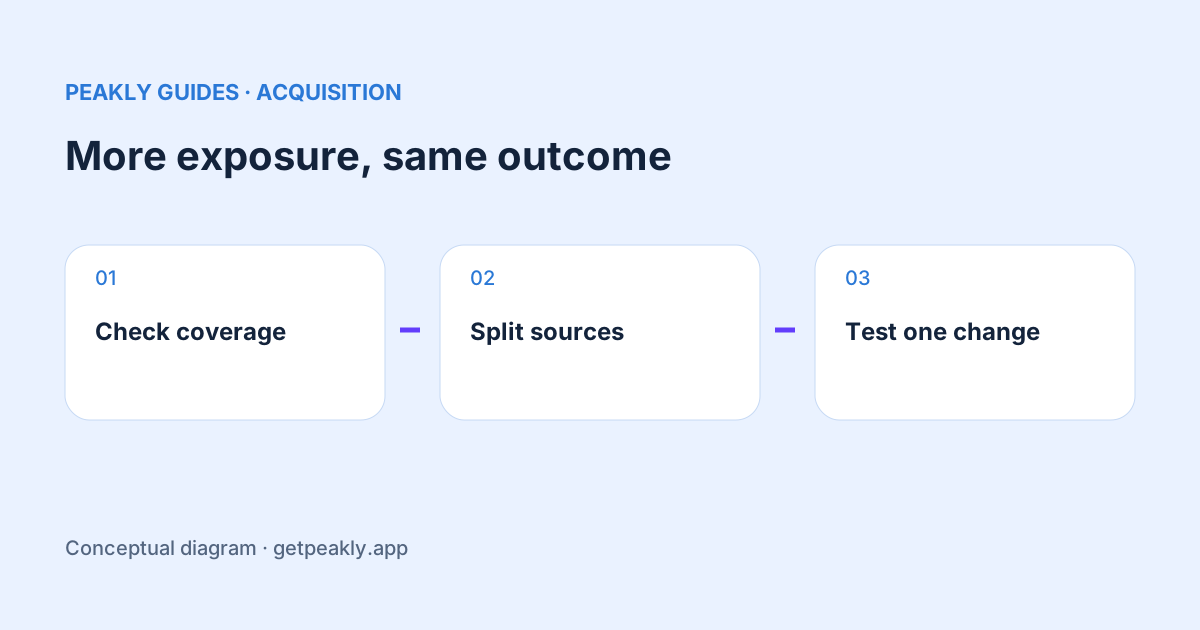
App Store impressions rising while downloads stay flat is a prompt to investigate the traffic and the measurement. It does not, by itself, prove that your screenshots are bad or that the store is showing your app to the wrong people. Start with equivalent periods and report coverage, then identify which source changed and where there is enough evidence to act.
Confirm that the movement is comparable
Use the same app, date range length, and filters for both periods. Compare matching weekdays when that is practical, and note a release, feature placement, campaign, or pricing change. A launch weekend and an ordinary midweek interval are different contexts, even when they contain the same number of days.
Check report coverage before calculating a rate from the latest days. If one input is still unavailable, a neat line chart can make the situation look more settled than it is. Write down whether the evidence is complete enough for the question rather than silently filling the missing value with zero.
Identify the source behind the extra exposure
Break out the sources instead of diagnosing only the combined total. If browsing grew while search stayed steady, the combined rate can change because the mix changed. Investigating a source that did not move would be an inefficient response. The practical question is where the additional reported exposure occurred and what outcome accompanied it.
Apple's acquisition documentation explains the source categories. Keep the labels attached to the comparison. In particular, a broad source bucket is not a keyword-level explanation, and it cannot prove that a particular audience saw a specific creative. Use the detail available without inventing the detail that is missing.
Separate a mix change from a within-source change
Consider a hypothetical app with 1,000 search impressions and 100 search downloads in each of two weeks. Browse impressions rise from 200 to 2,000, while browse downloads stay at 20. Total exposure grows sharply, but the search result is unchanged. The combined download-per-impression ratio falls because browse contributes much more exposure with little additional acquisition.
That example is illustrative, not a Peakly customer result. It shows why a declining total rate can coexist with stable performance in one source. Calculate comparable source-specific measures before deciding where to investigate. Download sources provides a fuller explanation of counts, shares, and the limits of attribution.
Look at the page without assuming every download visits it
Compare product page behavior with the acquisition paths described in the reports. A view of the full page and a download directly from a result card are different interactions. The asset you choose to test should match the part of discovery you are investigating. Rewriting a long description is not automatically the relevant response to a search-result question.
If the full page appears to be the weak point, first check page conversion and sample size. A low estimate from a few observations is a different situation from sustained evidence across a larger sample. Peakly's diagnosis uses the interval and its stated heuristic; it does not identify the creative element responsible for the result.
Form one testable explanation
Write an explanation as a hypothesis: “The first screenshot may not communicate the main use case to visitors from this source.” Then choose one change that could address it. Decide the outcome you will examine and a reason to doubt the result before replacing the asset. Keeping the hypothesis explicit prevents a suggestion from becoming a fact.
For a supported creative test, use Apple's product page testing tools and interpret their own result. For a simple before-and-after change, record the other changes in the period and remain cautious about causality. The screenshot testing guide explains why those forms of evidence should not be treated as equivalent.
Decide whether to act, investigate, or wait
A clear within-source change with adequate evidence can justify a focused experiment. A major coverage issue calls for a reporting check. A very small or uncertain sample can justify keeping the listing stable and collecting more relevant evidence. Waiting is useful when it protects your ability to interpret the next comparison.
Explore Peakly to review the counts, source mix, and suggested next steps together. Peakly offers possible reasons and something to try; you still choose and run the test. The objective is to spend effort on the part of discovery the evidence supports, rather than react to a dramatic impression total alone.