
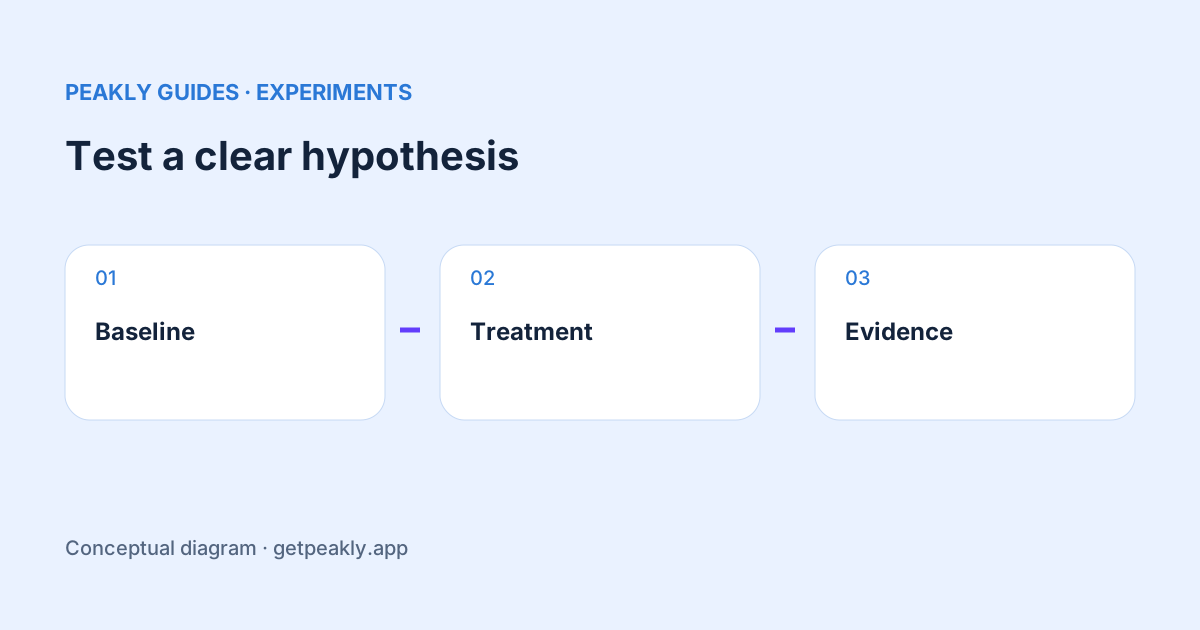
App Store screenshot tests are useful when they answer a specific question about how your listing communicates value. Choose one message or creative change, define what success would mean, and use the appropriate test evidence. A higher conversion rate after an edit is encouraging, but a simple before-and-after comparison cannot isolate the edit from changes in traffic or timing.
Start with the problem the screenshot should solve
Write a hypothesis that connects the asset to a visitor's uncertainty. For example: “The first screenshot does not show that the app works offline, so visitors who need offline access may miss the benefit.” That gives a proposed treatment a purpose. “Make the screenshots nicer” is harder to assess because it does not identify the misunderstanding you are trying to resolve.
Keep the actual app experience consistent with the message. A treatment that implies an unavailable feature might earn attention while creating a worse experience after download. Review the promise as carefully as the typography. The useful outcome is qualified acquisition, not a visual change that makes an isolated percentage look attractive.
Use a supported controlled comparison
Apple's Product Page Optimization compares treatments with a baseline and reports estimated conversion, relative lift, and its own Bayesian confidence. Its better or worse labels use at least 90% confidence. Follow Apple's testing documentation for supported assets and current setup rules.
Keep this result separate from Peakly's 95% Wilson interval diagnosis. Peakly assesses reported page-conversion evidence against a stated target; it does not run Apple's experiment or supply the experiment's winner. These analyses answer different questions. An app can clear a heuristic target while an individual creative test remains inconclusive.
If you change screenshots without a controlled test, call the review a before-and-after comparison. It can help generate another hypothesis, but the new week may contain a different mix of visitors. Record those differences rather than presenting the sequence of two events as proof that one caused the other.
Decide what to change and what to leave stable
Give the treatment one coherent purpose. You might make the main benefit more explicit while keeping the other screenshots unchanged. Changing the headline, icon, pricing, audience, and onboarding at the same time leaves too many possible explanations for the result. The point is to make the comparison interpretable, not to prohibit every ambitious creative idea.
Record the treatment, baseline, start date, audience context, and outcome before examining the results. Note releases or promotions during the test. Keep a screenshot of each creative and the wording you intended it to communicate. These records make it easier to explain the learning even if the treatment is not adopted.
Interpret lift without hiding the baseline
In an illustrative example, a rate rising from 10% to 12% increases by two percentage points and has a 20% relative increase. Those are two descriptions of the same arithmetic, not two separate gains. Show the baseline, new estimate, counts, and uncertainty so a large relative number does not stand in for the evidence.
Use the test's reported analysis for a Product Page Optimization decision. Do not replace it with a hand-calculated ratio from an unrelated report. The denominators and statistical approach may differ. The conversion guide explains why metric definitions and sample sizes need to travel with the percentage.
Treat inconclusive as a result you can learn from
An inconclusive test does not prove that the treatments are identical. It may mean that the evidence does not distinguish them well enough for the decision. Ask whether the proposed change was meaningful, whether enough relevant traffic reached the comparison, and whether the test was addressing the right part of discovery.
Repeatedly checking for a favorable-looking moment encourages selective interpretation. Use the experiment's prescribed analysis and a decision plan rather than declaring victory on the first attractive day. If the evidence remains uncertain, document that uncertainty and decide whether to keep the original, revise the hypothesis, or test later.
Connect the result to a next step
Before adopting a treatment, check that its message remains accurate and that the result applies to the context you care about. Monitor relevant downstream indicators without assuming same-period totals follow the tested visitors. A listing experiment answers a listing question; it does not automatically establish long-term retention or revenue impact.
Use the impressions and downloads diagnostic if you are unsure which part of discovery deserves a test. Explore Peakly for observations, possible explanations, and a suggested next step grounded in the reports. You choose the treatment, run the experiment, and assess what the outcome actually supports.