
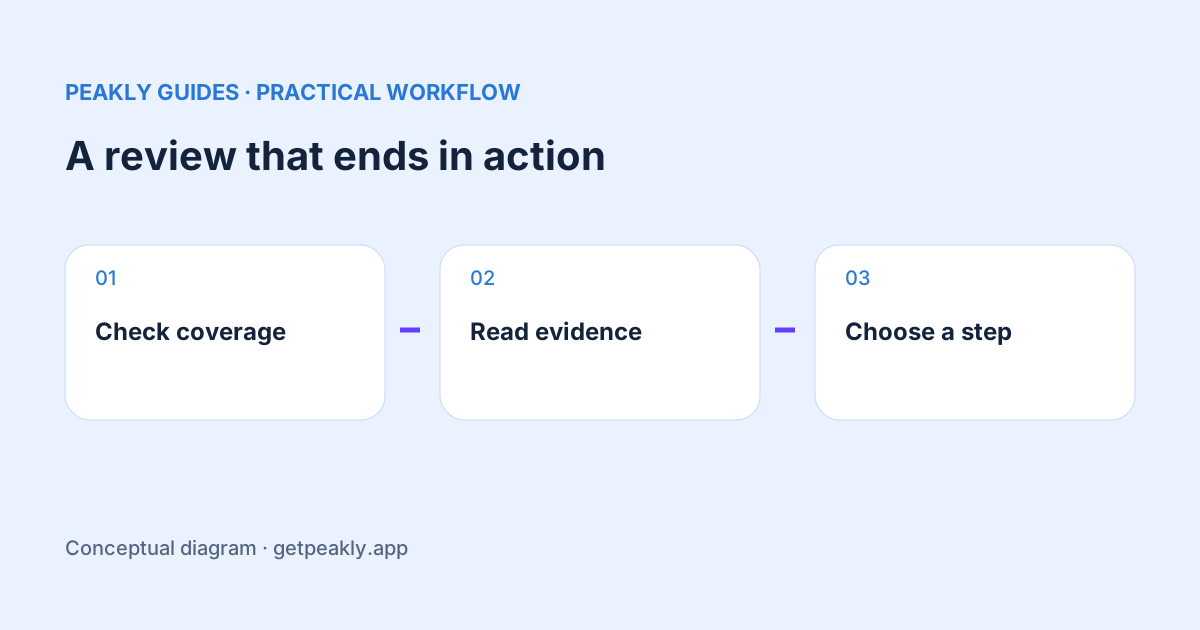
A weekly App Store analytics review should end with a decision, not a folder of screenshots. Use a repeatable window, check coverage, inspect acquisition and conversion, and review relevant purchase activity. Finish by recording one hypothesis and one next action. For a small app, an honest decision to wait for clearer evidence can be more useful than changing the listing every week.
Start with a stable review window
Choose the app and period you will review, and use comparable filters in the previous period. Record the dates rather than relying on a dashboard preset whose meaning changes each time you open it. Note releases, promotions, pricing changes, or unusual interruptions so the next review has context.
A weekly routine does not require pretending that seven days is always enough evidence. Some questions need a longer window, especially when traffic is limited or outcomes take time to arrive. Keep the review cadence separate from the measurement window. You can review every week while leaving a longer experiment or trial cohort unfinished.
Check whether the evidence is ready
Before interpreting movement, mark any unavailable or unsettled report days. Read the coverage guide if a gap is being mistaken for a decline. Record whether the comparison uses complete and equivalent inputs. A temporary coverage issue should not become an urgent product change just because the line chart looks dramatic.
Use Apple's reporting differences when totals from different surfaces disagree. The review should preserve the metric labels and scopes. It is easier to investigate a clearly named discrepancy than to revisit a note that only says “downloads looked wrong.”
Inspect acquisition as counts and sources
Write down the relevant impression and download counts, then identify the source that changed most. Keep absolute changes alongside shares. A channel's share can shrink because another channel grew, so a falling percentage is not automatically a deteriorating result. Choose the source-level question before recommending a distribution change.
Use the source guide to distinguish the routes into the listing. Avoid assigning a precise keyword or campaign explanation to a broad bucket that does not provide it. If the acquisition shift is unclear, make “investigate the source mix” the next action instead of inventing a creative fix.
Review conversion with its denominator
Record which conversion measure you are reading and the counts behind it. Check the conversion guide before labeling the percentage good or bad. Small samples and overlapping uncertainty can leave the conclusion open even when the number itself appears precise.
If impressions rose without additional downloads, use the diagnostic guide to separate a mix change from a within-source change. If a creative test is running, use that experiment's own analysis rather than announcing a winner from the weekly aggregate. The review is a checkpoint, not a substitute for the experiment design.
Keep purchases and later outcomes in context
For an app with purchases, record the measure you intend to monitor and whether the available report answers that question. Keep sales activity separate from settlement. For trials, note which offers have had time to finish and whether you are examining a cohort or an estimate. A download increase alone does not establish that acquisition is paying for itself.
Check any downstream comparison for a population mismatch. Activity this week may come from people who downloaded earlier. Use the evidence to notice a question worth investigating without presenting same-period totals as linked customer histories. The trial conversion guide gives a worked example of this timing problem.
Write a short decision note
Use four sentences: what changed, what the reports actually support, what might explain it, and what you will do next. For an illustrative note: “Search exposure increased. The page-conversion evidence remains uncertain. A broader audience may be involved. Keep the listing stable and review the source breakdown after more data arrives.” The explanation stays explicitly tentative.
If you choose a test, add the asset or behavior being changed, the outcome to watch, and a reason the result might be misleading. Choose one interpretable action you can actually carry out. Changing several unrelated elements may feel productive while making next week's review much harder to understand.
Return to the previous note
At the next review, begin with the earlier decision. Check whether the action happened and whether enough relevant evidence has arrived. Do not silently replace an unfinished question with a more exciting chart. Keeping a modest decision history helps you learn from both useful tests and inconclusive ones.
Explore Peakly for observations, possible explanations, a suggested test, and what to measure afterward. Peakly does not automatically execute the action or maintain proof of its result. The weekly note is your bridge between reading the reports and making an accountable, appropriately cautious decision.